



 MNK Main Building
al. 3 Maja 1, 30-062 Kraków
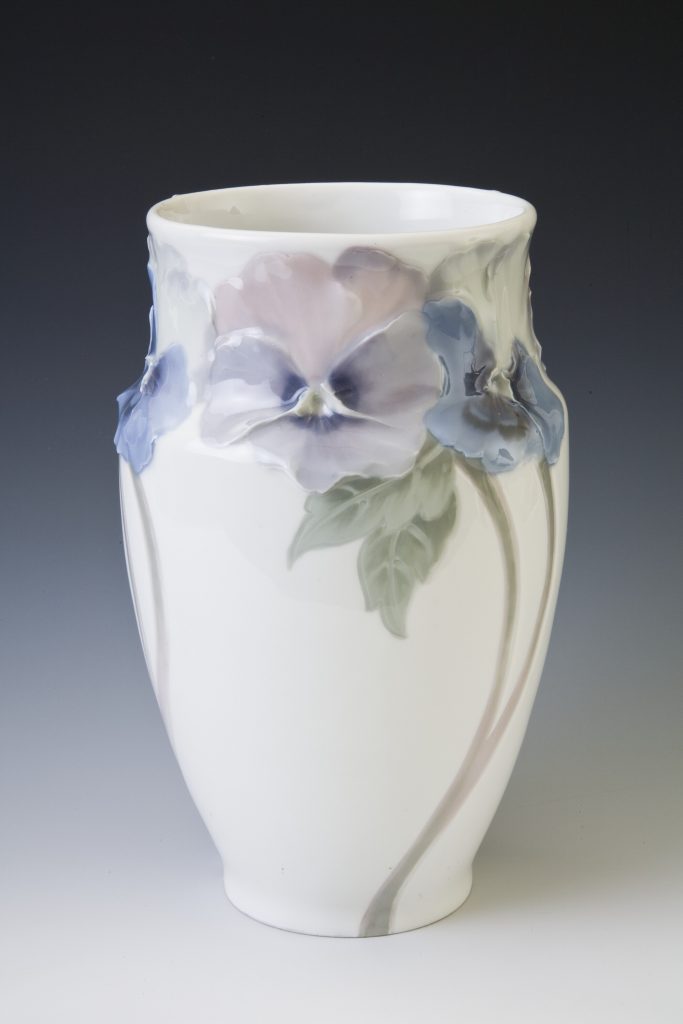
Rörstrand, Sweden, ca. 1900, porcelain, applied and underglaze painted decoration
The manufactory in Rörstrand near Stockholm was founded in 1726 as a faience factory; porcelain production began there in 1797. The factory primarily served the needs of the royal court and the Swedish aristocracy, producing elegant, high-quality porcelain services which—as researchers note—lacked an original style. A change occurred only at the end of the 19th century when, following the example of Danish porcelain factories, a new, exceptionally white porcelain paste was introduced and subtle underglaze painting was adopted. The painter and designer Alf Wallander (1862–1914), the factory’s artistic director, is considered the creator of the Rörstrand porcelain style. Some Swedish vessels featured decorations similar in style to the paintings found on Danish porcelain; initially, Far Eastern influences were distinct, but native themes were soon introduced, with a preference for local flora and fauna. However, among the most interesting and characteristic products of the Rörstrand factory were vessels decorated with applied, delicately tinted plant motifs that “grew” around the bellies of the vases or decoratively entwined their rims.
The collections of the National Museum in Krakow contain only a few examples of this magnificent Art Nouveau porcelain—among them a vase with pansies, decorated by Mela Anderberg, who was associated with the manufactory from 1897. All Rörstrand objects were donated by Teodor Dunin in 1909 and are on display in the Gallery of Decorative Arts.
We invite you to explore more about this object in the digital catalogue of the National Museum in Kraków. Author of the entry: Bożena Kostuch
MNK Main Building
al. 3 Maja 1, 30-062 Kraków