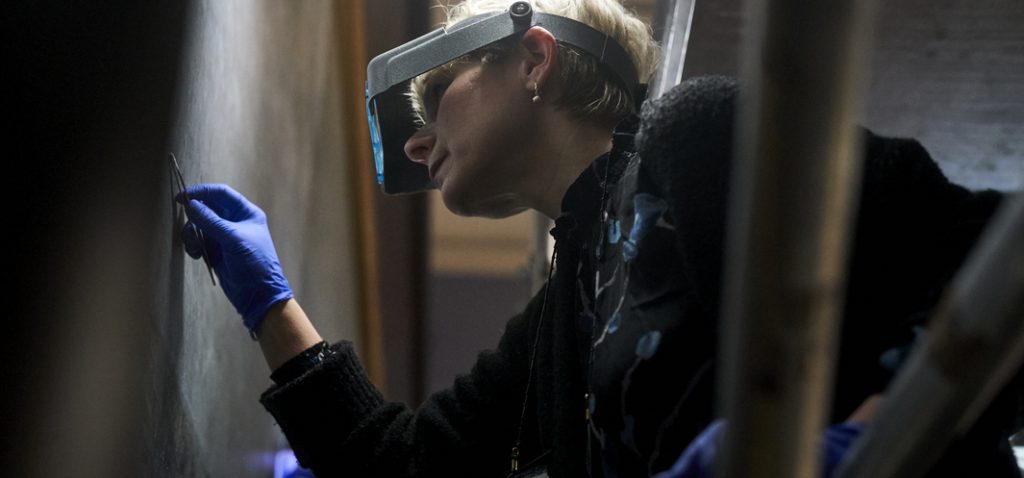
Workshop team:
+48 12 433 54 40, +48 12 433 54 11
The Painting and Sculpture Conservation Workshop at the MNK Sukiennice combines tradition with modernity. It is the oldest of the twelve workshops making up the Conservation Department of the National Museum in Kraków – its history dates back to the early 20th century. In 2010, it was completely modernised and refitted.
The Workshop’s activities are focused on the protection and conservation of 19th-century paintings held in the collections of the National Museum in Kraków. It carries out a variety of projects: full, partial and preventive conservation, often undertaken as a team, which is a key aspect of the work. As part of its preventative conservation work, the workshop looks after the museum’s collection of 19th-century Polish paintings on display at the MNK Sukiennice, the MNK Matejko House and the painting exhibition at the Royal Castle in Niepołomice ‘MNK Sukiennice in Niepołomice 2’ and the collection of paintings at the MNK Matejko House, as well as the works stored in the depots. Conservators monitor the condition of objects on display in the galleries and those stored in the storerooms; they monitor storage conditions, taking into account relative humidity (RH) and temperature; and they draw up condition reports for objects on loan. During the transport of museum objects, they provide conservation care, assuming the duties of a courier. The conservation of objects is often accompanied by scientific research aimed at understanding the techniques and technologies used in the work undergoing conservation treatment. Conservation documentation is drawn up from this work and entered into the MUZA museum system. Furthermore, we carry out research projects concerning the work of nineteenth-century artists, as well as conservation techniques and methods.
The Studio’s team also carries out research activities related to ongoing conservation work and as part of research projects. Between 2004 and 2010, as part of the ‘New Sukiennice’ project, the Studio conserved several dozen paintings prepared for a new exhibition at the MNK Sukiennice Gallery of 19th-Century Polish Art. These included large-format canvases by MNK Matejko and Henryk Siemiradzki’s Nero’s Torches. The most recent large-scale undertaking was the restoration of Józef Chełmoński’s The Four, which ran from 2020 to 2024 and was accompanied by research
2020–2024
Józef Chełmoński, The Four, 1881, MNK II-a-258, oil on canvas, dimensions 286 x 680.5 cm.
The history of the painting – having been rolled up onto a tube on numerous occasions, transported many times and hidden during the wars – has had a negative impact on its state of preservation. Thanks to the relining carried out in the 1970s and the use of a self-tensioning frame with programmable operation in 2007, the painting was in good structural condition. However, distinct vertical cracks in the paint surface, superficial water stains, discoloured retouching and, above all, darkened varnishes impaired the visual perception of the work, distorting its colour scheme and flattening the pictorial perspective. Due to the large format of the painting, the restoration work was carried out from scaffolding in situ in the gallery. It primarily involved cleaning the delicate paint layer of the secondary layers that had accumulated on it. The work began with tests and the selection of methods and materials to ensure the safe removal of discoloured varnishes covering the painting and accumulated in the recesses of the impasto, as well as retouching that had changed colour to conceal damage to the original. This painstaking process, requiring the utmost care, was carried out in the most delicate areas using compresses, so as not to rub the paint layer whilst cleaning it. Following the cleaning of the picture surface, the few losses in the canvas and ground were filled in, and the painting was retouched and varnished. Thanks to the four-year restoration, it was possible to restore the aesthetic qualities of the work, as well as the composition and colour scheme of *The Four*, which had been distorted by discolouration.
Technological analyses of the painting were carried out in parallel.
Conservation team: D. Sarkowicz, M. Sieklucka, G. Banach-Kielanowska, J. Zwinczak, J. Kędziora, E. Gracheff.
* D. Sarkowicz, M. Sieklucka, G. Banach-Kielanowska, J. Zwinczak, J. Kędziora, A. Klisińska-Kopacz, A. Kopyciak, P. Krupska-Wolas, K. Skóra, A. Ryguła, M. Obarzanowski, T. Wilkosz, S. Tańcula, B. Feluś, G. Gąsecka, M. Matosz, Galloping Through the Centuries – Conservation and Research on Józef Chełmoński’s painting ‘The Four’, 1881, Acta Universitatis Nicolai Copernici: Heritage Studies and Conservation LV (2024)
________________________________________________________
2019–2021
Conservation of a collection of paintings by MNK Matejko in connection with a monographic exhibition of the artist’s work: The Departure of the Students from Kraków in 1549; Portrait of Mikołaj Zyblikiewicz, Male Nude, Study of a Male Bust, Portrait of a Boy, Portrait of an Old Man, Still Life
MNK Matejko, The Departure of the Students from Kraków in 1549, 1893, oil on canvas, dimensions 97 × 194 cm, MNK IX-20
The canvas was damaged by recurring vertical tears. The damage, resulting in part from improper storage during the war and subsequent repairs, had a very negative impact on the work’s aesthetic appearance. The backing applied in 1947 failed to stabilise the support, and distinct distortions were visible on the front of the canvas. The yellowed varnish, together with soiling, altered and darkened the work’s original colour scheme, whilst the retouches had become discoloured. Conservation work began in 2021. The front surface was cleaned of dirt, yellowed varnish, old altered retouching and overpainting; the old lining was removed; and repairs were carried out on the support by gluing together tears and applying prosthetic patches. The support was impregnated and a new lining was applied with a Hollytex interlayer; putty was applied to areas where the plaster had crumbled, and the painting was stretched onto a new stretcher. Losses in the paint layer were restored using an imitative technique, incorporating elements of reconstruction. The conservation work has restored the work’s aesthetic qualities and halted the process of deterioration. It was possible to correct the deformations and permanently level the surface of the painting; vertical damage no longer detracts from the composition. Following conservation, the painting was exhibited at the exhibition MNK Matejko. The Painter and History, and subsequently returned to the permanent exhibition at the Jan Matejko House. Conservationists: D. Sarkowicz, M. Sieklucka.
*D. Sarkowicz, M. Sieklucka, Restoring Lost Qualities – Jan Matejko’s Paintings at the Painting and Sculpture Conservation Workshop at the MNK Sukiennice [in:] MNK Matejko. The Painter and History, exhibition catalogue, Kraków 2023
_______________________________________________________________________
2018 / 2019
AN, The Battle of Kalisz in 1706, oil on canvas, dimensions 258 x 258 cm, MNK XII-438
The painting was one of three conserved at the MNK Sukiennice in preparation for display at the MNK Czartoryski Museum of the 20th Century as part of the ‘Past of the Future’ project. The work involved reattaching flaking sections of the paint layers and aesthetic conservation of the painting’s surface.
The painting was soiled, covered with yellowed varnishes, and featured numerous losses and restorations in the paint layer, as well as overpainting. The surface was cleaned, and the old varnishes, colour-altered retouches and overpainting were removed. Losses in the ground and paint layers were filled, and fragments of the composition were reconstructed.
For the first time in the workshop’s history, new, optically stable synthetic resins and Gamblin paints based on these binders (Laropal A81, Regalrez 1094) were introduced for retouching and varnishing. The conservation work was combined with research into the painting’s technical execution. The work was carried out in an open studio, in the temporary exhibition hall at the MNK Sukiennice, which is accessible to the public, allowing visitors to observe the conservation process.
By J. Zwinczak, D. Sarkowicz, G. Banach-Kielanowska, M. Sieklucka, E. Zygier.
2017/2020
Maksymilian Gierymski, Winter in a Small Town, 1872, MNK ND 12339, oil on canvas, dimensions 76 x 128 cm
The work, previously considered a war loss, was rediscovered in 2017 and transferred to the MNK in a very poor state of preservation, rolled up and with numerous losses. The conservation of the work was comprehensive, involving a range of technical and aesthetic interventions. Owing to the archival value of the manufacturer’s stamp imprinted on the reverse of the support, a transparent silk lining was applied, combined with edge strips of linen canvas. Numerous losses in the paint layer were filled using Gamblin paints based on Laropal A81 resin binder. The painting was coated with a final varnish based on Regalrez 1094 resin.
By halting the process of the work’s progressive deterioration, its original artistic and exhibition qualities have been restored. The painting was also subjected to technical analyses as part of a project concerning the workshop of Maksymilian Gierymski.
By: M. Sieklucka, E. Zygier
2017
Michał Stachowicz, Kościuszko’s Oath, MNK-IIa-580, tempera on canvas, dimensions: 164 x 301 cm.
The painting is one of four parts of the decoration for Tadeusz Kościuszko’s catafalque, displayed in Wawel Cathedral in 1818, created by Michał Stachowicz. Owing to the relatively fragile medium (tempera on canvas) and the work’s history, the painting was in poor condition.
It had numerous losses; in many places, the paint layer, together with the ground, had detached from the support, and the surface was soiled, amongst other things, by extensive water stains. Comprehensive technical and aesthetic conservation of the painting was carried out, including impregnation and relining onto a new canvas, as well as the reconstruction of missing sections of the paint layer. Following conservation, the painting is currently on display at the Presidential Palace in Warsaw, adorning the interior of the staircase. Conservators: G. Banach-Kielanowska, D. Sarkowicz, M. Sieklucka, E. Zygier, M. Tarnowska-Reszczyńska, J. Zwinczak
*G. Banach-Kielanowska, D. Sarkowicz, M. Sieklucka, E. Zygier, “’The Oath of Tadeusz Kościuszko’ – a painting by Michał Stachowicz from the decoration of the catafalque of the leader of the uprising – history and conservation of the work”, Proceedings of the National Museum in Kraków, XI (2018), pp. 51–69.
Project carried out by: Joanna Zwinczak in collaboration with Dr Marek Bucki and Prof. Krzysztof Kruczała, PhD.
The aim of the project was to identify the causes and mechanisms of ageing in retouching and to propose a suitable technique and set of materials for filling gaps in paint layers. Six of the most commonly used retouching paints in the studio – both commercial and modified – containing ultramarine and cadmium yellow were subjected to artificial ageing at elevated temperature and under artificial light, as well as, for comparison, to natural ageing for four years, away from light. The samples were then analysed using ATR FTIR spectroscopy, EPR spectroscopy and spectrophotometry, as well as an analysis of changes in wettability and a manual solubility test. These analyses made it possible to outline the ageing profile of the binders and to identify the materials that are both the most chemically stable and the most soluble in the future.
Publications:
M. Bucki, J. Zwinczak, K. Kruczała, Research into physicochemical changes in the retouching paints used at the National Museum in Krakow [in:] npj Heritage Science, vol. 13, article no. 370, 2025
https://www.nature.com/articles/s40494-025-01720-z
Joanna Zwinczak, Krzysztof Kruczała and Marek Bucki, Retouches of the paint layer: Research into physical and chemical changes of the materials used in conservation studios at the National Museum in Kraków [in:] Technart23 Book of Abstracts, p. 212https://iris.unive.it/retrieve/c46d9787-d946-4877-a6a5-47f8c41fa59d/TECHNART2023%20book%20of%20abstract.pdf
Between 2012 and 2015, the research was carried out as an internal project of the National Museum in Kraków; from October 2015 to October 2020, it continued as part of the project ‘Corpus of Henryk Siemiradzki’s Paintings’*, led by Prof. Jerzy Malinowski. Source of funding: Ministry of Science and Higher Education: NPRH (“Tradition I a”, contract no. 0504/NPRH/H1a/83/2015). This project was carried out in collaboration with the Polish Institute for the Study of World Art, the National Museum in Warsaw, and the State Tretyakov Gallery in Moscow.
Research leader: Dominika Sarkowicz
Project participants (National Museum in Warsaw): M. Sieklucka, A. Klisińska-Kopacz, M. Matosz, M. Obarzanowski,
P. Frączek, K. Budkowska
*The Corpus of Henryk Siemiradzki’s Paintings, vols. 1–4, edited by Jerzy Malinowski, Polish Institute for World Art Studies & Tako Publishers, Warsaw – Toruń 2020; ISSN 2719-7212, ISBN 978-83-66758-02-5 PISnSŚ, ISBN 978-83-7581-371-5 MNK
vol. 4: The Painting Technique of Henryk Siemiradzki, D. Sarkowicz (ed.),
The aim of the project was to analyse Henryk Siemiradzki’s painting technique on the basis of detailed studies of selected oil paintings by the artist from the MNK collection and other museum and private collections in Poland and abroad. The research involved identifying the materials used by the artist, analysing his technique and identifying elements of the creative process. At the National Museum in Kraków, 75 of the painter’s oil paintings were analysed.
This has resulted in numerous publications, technical notes on selected paintings and a chapter in volumes 1–3 of *The Corpus of Henryk Siemiradzki’s Paintings* (ed. Malinowski, 2020). A summary of the research findings is presented in volume 4 of *The Corpus…*, published thanks to a grant from the Ministry of Culture and National Heritage:
‘Henryk Siemiradzki’s Painting Technique’ (ed. Sarkowicz, 2022). Warsaw–Kraków–Toruń, 2022
__________________________________________________________________________
The work of Maksymilian Gierymski and the art of Polish artists in Munich between 1867 and 1900 – an interdisciplinary study. A project carried out at the National Museum in Kraków between 2013 and 2018, funded by the National Science Centre under decision number DEC-2012/05/B/HS2/03970.
Project team: Dr A. Krypczyk de Barra – project leader, E. Zygier, Dr A. Klisińska-Kopacz, P. Frączek.
*‘Maksymilian Gierymski. Catalogue of Collected Works’, A. Krypczyk-De Barra (ed.), Kraków 2019.
Publications:
_____________________________________________________________________
Conservation studies of paintings by Rafał Hadziewicz from the collections of the National Museum in Kraków and the National Museum in Kielce. An internal project of the National Museum in Kraków carried out in 2009 and 2014–2016.
Publications:
Compilation of a catalogue of original works (paintings, watercolours, gouaches and drawings) by Michał Elwir Andriolli held in Polish and foreign collections. Duration: 2015 to 2026
Project coordinator: Gabriela Banach-Kielanowska.
To date, Andriolli (1836–1893) is known chiefly as the finest illustrator of Adam Mickiewicz’s *Pan Tadeusz*. In total, he produced illustrations for sixty-five Polish and foreign literary works, as well as for magazines such as *Kłosy*, *Tygodnik Ilustracyjny* and *Wieniec*. His drawings and gouaches were carved onto boxwood blocks by outstanding wood engravers (a compiled list of over 50) and reproduced in thousands of copies. Andriolli often painted his gouaches directly onto the boxwood block, which was then lost beneath the skilful chisel of the wood engraver.
Two fires in his studio, situated in a wooden house – a villa on the Świder River near Warsaw – irretrievably destroyed the archive of his collected works. Nevertheless, many surviving works have been found in museum collections, as well as in churches in Poland and Kaunas.
The most significant discovery during the search was contact with the Viktor and Apolinary Wasniecow Museum in Kirov (formerly Vyatka, where Andriolli spent eight years in exile). The museum houses numerous works by him, including landscapes, portraits and religious paintings in oil. Furthermore, between 1869 and 1871, Andriolli created iconostases for two Orthodox churches. Between 1883 and 1886, Andriolli stayed in Paris at the invitation of the publishing firm Firmin-Didot, which entrusted him with work following the death of their eminent illustrator, Gustave Doré. We know that he illustrated several books and worked for two magazines, *Illustra*tion” i „Le Figaro”, wykonał ponad 600 ilustracji. Przeprowadzono prywatnie poszukiwania w Paryżu, ale nie natrafiono na żadne prace przygotowawcze w postaci nawet rysunków.
The conservation workshop has been associated with the MNK Sukiennice almost since the Museum’s inception; formally, it has been operating with permanent staff for several decades. Its establishment marked the culmination of efforts to ensure professional care for the growing collection and, at the same time, opened a new department that was vital for the preservation of the collections. Before the workshop was established with a permanent conservator’s post, conservation work was commissioned from external contractors, most often painters. Among them, Władysław Pochwalski (1860–1924) rendered outstanding service to museum conservation, restoring oil paintings on both canvas and wooden panels. Many of the works on display at the Gallery of 19th-Century Polish Art in the MNK Sukiennice still bear traces of those interventions, carried out either by Pochwalski himself or under his supervision. The scope of the work was varied – ranging from preventive conservation, through surface cleaning, to the application of varnish to the paint layers. Products from the industrial chemistry sector – which had been developing rapidly since the 19th century – were utilised, including an ever-widening range of artistic and conservation materials. Some of these historical preparations have been preserved in their original packaging and are still carefully stored in the MNK Sukiennice; they have also become the subject of a scholarly study*.
The Painting and Sculpture Conservation Workshop, with a full-time conservator, was established in 1935.
*E. Doleżyńska-Sewerniak, E. Zygier, ‘Conservation materials used in the former Painting and Sculpture Conservation Workshop at the MNK Sukiennice’, Opuscula Musealia, 20, pp. 109–128.
*M. Gołębiowski, E. Doleżyńska-Sewerniak, E. Zygier, “Chemical analysis of historical art materials from the National Museum in Kraków using gas chromatography–mass spectrometry (GC-MS)”, Spectroscopy Letters, 2013. DOI:10.1080/00387010.2013.772901
Between 1928 and 1935, the Museum’s management commissioned Mieczysław Gąsecki (1883–1948) to carry out conservation work. Gąsecki was a painter and a highly regarded restorer, known in artistic circles, amongst other things, for his friendship with Jacek Malczewski. He was entrusted with the museum’s paintings, which were sent to his private studio, though he also carried out work on site at the MNK Sukiennice. He continued to collaborate with the National Museum in Kraków even after the Museum had established its own conservation studio with its own staff.
The first person to be employed on a permanent basis was Anna Skraszanka-Szuster (1908–1948) – a Master of Philosophy, art historian and graduate of painting and painting conservation at the Academy of Fine Arts in Kraków. Archival records indicate that she set up the first workshop in the MNK Szołayski House at 11 Szczepańska Street, but the conservation work documented during this period on MNK Matejko’s large canvases *Kościuszko at Racławice* and *Wernyhora* was certainly carried out in the MNK Sukiennice.
The outbreak of the Second World War shaped conservation activities for many years to come. It became necessary to evacuate the collections and safeguard them, and, after the war ended, to conserve the damaged works. In 1945, the Workshop’s most important task was the conservation of Jan Matejko’s *The Prussian Homage*. This was carried out at the MNK Sukiennice, with the participation of the conservators employed there – Anna Skraszanka-Schusterowa and Irena Bobrowska – as well as Mieczysław Gąsecki. The work carried out attracted considerable attention and was documented by the press (MNK Matejko’s Masterpiece Returns to Its Former Glory, *Przekrój* 14, 15–21 July 1945).
From the 1960s onwards, the importance of museum conservation grew, leading to the expansion of the workshop. In 1961, Maria Niedzielska (1923–2012) set up a small chemical laboratory at the MNK Sukiennice to carry out research on artefacts.
In the years that followed, the workshop expanded. Two large rooms, together with small storage areas, were allocated for its operations. Successive heads of the workshop expanded the team of specialists looking after the museum’s collections. In the 1990s and 2000s, the workshop employed as many as a dozen or so qualified conservators and restorers, which made it possible to tackle the challenges of conserving large-format paintings.
In 2005–2006, in connection with the planned renovation of the MNK Sukiennice, the entire 19th-century art collection (from the galleries and storerooms) was relocated, along with the temporary relocation of the conservation workshop. Part of the collection at the Royal Castle in Niepołomice was used to create the permanent exhibition ‘MNK Sukiennice 2’, which to this day, albeit in a modified form, remains under the ongoing care of the Painting and Sculpture Conservation Workshop at the MNK Sukiennice.
At that time, some of the conservators from the workshop at the MNK Sukiennice joined the team at the newly opened Painting and Sculpture Conservation Workshop at the Bishop MNK Ciołek Palace.
Thanks to funding from the Norwegian Financial Mechanism as part of the ‘New MNK Sukiennice’ project, between 2007 and 2010 the Painting and Sculpture Conservation Workshop at the MNK Sukiennice was completely modernised and equipped with the specialist equipment required for the examination and conservation of artefacts.
Heads of the workshop since 1935*:
– Anna Skraszanka-Szuster
– Irena Bobrowska
– Andrzej Załuski
– Teresa Maria Marek
– Anna Nowak-Tarnowska
– Czesława Bełz
– Krystyna Bartel-Bochnak
– Barbara Ptak
– Beata Nowak
– Elżbieta Zygier, currently Chief Conservator at the National Museum in Kraków
– Dominika Sarkowicz (since 2019)
* E. Zygier, ‘History of the Painting and Sculpture Conservation Workshop at the MNK Sukiennice’, Proceedings of the National Museum in Kraków, VI (2013), pp. 363–384.
Students and trainees from conservation departments in Poland (including an ongoing partnership with the Academy of Fine Arts in Kraków) and abroad (France, Ukraine, Belarus and Germany) undertake work placements and internships at the MNK Sukiennice Workshop.