


 MNK Main Building
al. 3 Maja 1, 30-062 Kraków
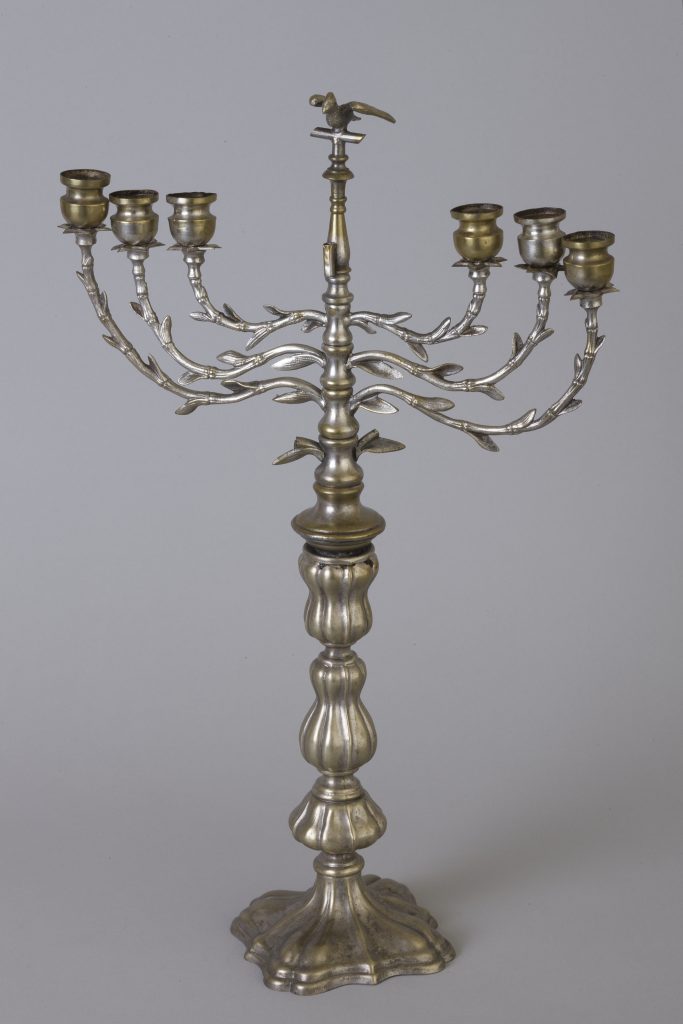
A Hanukkah lamp in the form of a menorah – a candlestick with a base of approximately square plan, profiled, slightly domed in the centre, upon which rests a baluster-shaped, profiled shaft topped with a figurine of a bird with outstretched wings. Attached to the shaft are arms in the form of three pairs of upward-curving leafy branches, ending in vase-shaped sockets for candles (one of the lowest pairs of arms is missing). The festival of Hanukkah is celebrated in commemoration of the rededication of the Temple in Jerusalem by Judas Maccabeus in 164 BCE, which took place on the third anniversary of its desecration by the Seleucids. The ritual of this festival, which usually falls at the turn of November and December, refers to the legend of the miraculous multiplication of the oil needed to light the Temple menorah. Throughout the eight days of the festival, Jews light lamps—one more each day—using eight-flame oil lamps or candlesticks designed specifically for this purpose; hence, it is also known as the “Festival of Lights.”
In synagogues, lights were lit on a candlestick whose shape mirrored the menorah from the Temple in Jerusalem. The first mention of lighting Hanukkah lamps in a synagogue—placed there for those who could not afford their own—appears in medieval rabbinic texts. This specific candlestick shape, featuring four pairs of arms branching from a central stem in the form of arched stalks ending in cup- or flower-bud-shaped sockets, was initially reserved exclusively for synagogue worship. Later, at the end of the 17th century, smaller candlesticks of this type also entered domestic use.
We invite you to explore more about this object in the digital catalogue of the National Museum in Kraków. Author of the entry: Monika Paś
MNK Main Building
al. 3 Maja 1, 30-062 Kraków