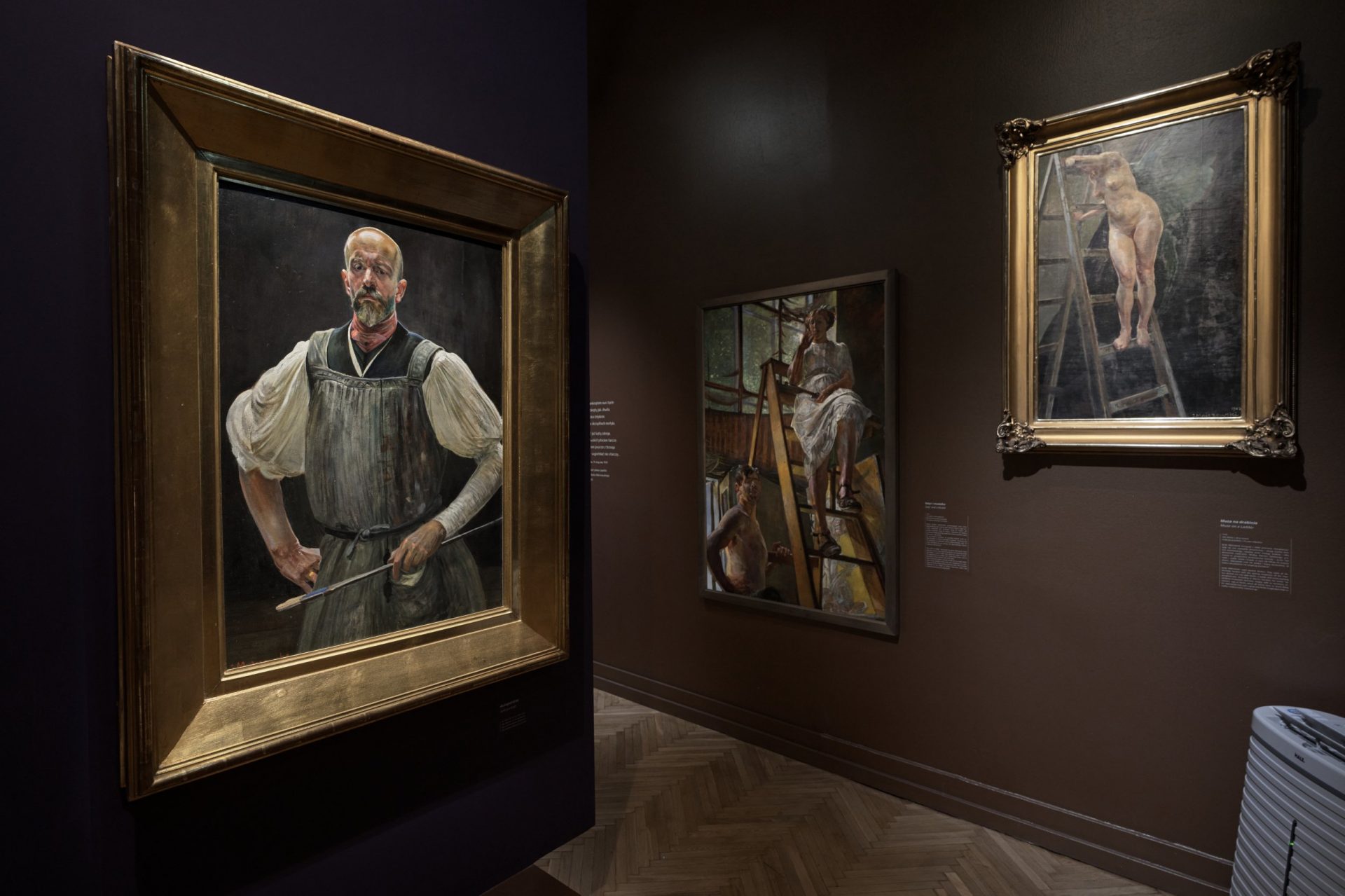
The National Museum in Kraków comprises twelve branches, located in the historic centre of Kraków and in Zakopane. The collections, which are looked after by its staff, number nearly a million exhibits. The most important and recognisable examples of Polish art: painting, sculpture, decorative arts and historical artefacts. Particular attention is drawn to the collections of European and Far Eastern art and crafts, gathered by collectors and subsequently incorporated into the MNK’s holdings, such as Leonardo da Vinci’s famous Lady with an Ermine or complete series of Japanese prints, prized by experts from around the world for the outstanding quality of the prints, including very early prints dating from the time of artists such as Katsushika Hokusai.
Every year we present selections from our collection in themed exhibitions, and thanks to the work of our research departments, the collections have been documented in numerous catalogues and studies. Storage, conservation and exhibition are just some of the ways in which we aim to ‘pass on’ information about the richness and diversity of these collections. Most of the MNK’s collection consists of artefacts that have long been in the public domain. As their custodians, we care for them and remember that, in accordance with current legislation, it is our duty to make them as widely accessible as possible. This is why our collaboration with the Wikimedia Polska Association, which promotes and supports Wikipedia and its sister projects: Wikimedia Commons, GLAM-Wiki. Since the start of 2022, we have been working alongside Wikipedians on a series of new initiatives: we are expanding the image database in the Wikimedia Commons repository, we invite you to collaboratively edit articles dedicated to our collections, and we are exploring how to utilise the tools available on Wiki platforms so that visiting our exhibitions becomes an opportunity to further expand both our and your knowledge.
On our website and social media, we announce upcoming events and initiatives related to the expansion of Wikipedia and our collaboration with Wikimedia Polska. If you are studying in Kraków, you can apply to take part in Wikipedia projects as part of a student placement in fields related to tourism, culture, the arts or marketing.
This was the guiding principle as we worked on the social responsibility mission statement Museum-People-Future.
Cultural heritage belongs to everyone. As museum professionals, we know full well what can be done with historic canvases, how to talk about them and why they are important. But do we know everything? Perhaps there is another way to use the common good to create something entirely new? Thanks to the accessibility of our digital resources, we are creating the opportunity to make practical use of cultural resources in any way we choose. – The common good is characterised by the fact that it does not diminish with consumption, and the public domain is a raw material from which new knowledge and new works are created. – write our colleagues in the Digital Centre’s publication: Domena publiczna w instytucjach dziedzictwa. Instrukcja [The Public Domain in Heritage Institutions. A Guide – PL] which we warmly invite you to read. It is this publication that we have used to present a few basic concepts regarding the public domain. Read it!
– open licences in which the creator grants broad (not directed at a specific entity or group of entities) permission to use their work and chooses the manner of its use. Creative Commons is an international project offering free legal solutions and supporting online tools that enable creators and institutions to manage the copyright of their works more conveniently. Creative Commons has been adopted as the primary legal framework by the Wikipedia project and numerous government bodies worldwide (including the Danish government’s public information service, ministries and government agencies, the Italian equivalent of the Central Statistical Office, the White House, and UNESCO’s educational programmes). The licences are adapted to the regulations of individual countries and updated by lawyers.
(crowd – from English ‘crowd’; sourcing – from English ‘sourcing’) – a practice involving collaboration with a group or community that performs tasks and duties traditionally assigned to employees of an institution/organisation/company.
In the case of GLAM sector institutions, the advantage of crowdsourcing is not only that this practice involves a given group or community in the institution’s work, but above all the fact that it offers the opportunity to turn to members of that group as experts on their own heritage and past.
Galleries, libraries, archives, museums) – an acronym used to describe the sector of publicly funded institutions whose aims are to collect, preserve and make accessible cultural heritage in the broadest sense. The acronym GLAM was popularised by the Wikimedia Foundation’s GLAM-WIKI initiative. This project was an attempt to encourage GLAM-type institutions to collaborate on creating and supplementing the content of Wikipedia. GLAM-WIKI provides support to cultural institutions wishing to collaborate with the Foundation on making open cultural resources available and creating them. Wikipedians believe that the creators of the online encyclopaedia and galleries, libraries, archives and museums should work more closely together, as they share common goals: the public presentation and widespread dissemination of knowledge.
– the development of new technologies has radically transformed the way cultural institutions operate. Technology has a significant impact not only on an institution’s internal operations and management, the fulfilment of its mission, and the building of relationships with its audience, but also on the care and dissemination of its collection. A strategic approach to all digital activities is therefore essential. The process of planning the institution’s development and its resource management policy – both online and offline – should comprise three steps:
– legal accessibility is of little use without technological accessibility. It is worth ensuring this and equipping databases with data exchange protocols to enable the further and full reuse of this data.
Technical accessibility is based on the principles of: perception – both information and user interface elements must be presented in an accessible manner; functionality – user interface elements and website navigation should allow for interaction; understandability – both content and interface operation; reliability – content must be prepared in such a way that it can be correctly interpreted, e.g. by assistive technologies.
– data about data; expressions describing the content and form of a document, having a specific structure in accordance with an accepted description standard. It is used to organise a collection of documents and thereby make it easier for users to find the information they need. Metadata is most commonly used to describe (in a uniform manner) electronic documents, e.g. those published in digital libraries. Metadata includes information such as the author of the work, title, publisher, co-author, year of publication, subject description, language, copyright holder, location of the original document, and file size
– an open, exchangeable and general metadata standard for describing web resources, developed with online access in mind. It is developed by the Dublin Core Metadata Initiative, whose primary aim is to create a standard enabling quick and easy searching of electronic resources. Dublin Core consists of 15 core elements. Each is defined using a set of 10 attributes, e.g. name, identifier, version, definition, comment, etc.
Source of definitions (you’ll find more there!): Domena publiczna w instytucjach dziedzictwa. Instrukcja – A collective work prepared as part of the booksprint on 04/12/2015. Publisher: Centrum Cyfrowe, Museum of Polish History, Open Education Coalition. Authors: Aleksandra Janus, Dominika Paleczna, Agnieszka Leszyńska, Kamil Śliwowski, Klaudia Grabowska, Agata Śladowska, Ewa Majdecka, Katarzyna Werner-Mozolewska, Dorota Szkodzińska, Marcin Wilkowski, Katarzyna Strycharz, Natalia Mileszyk