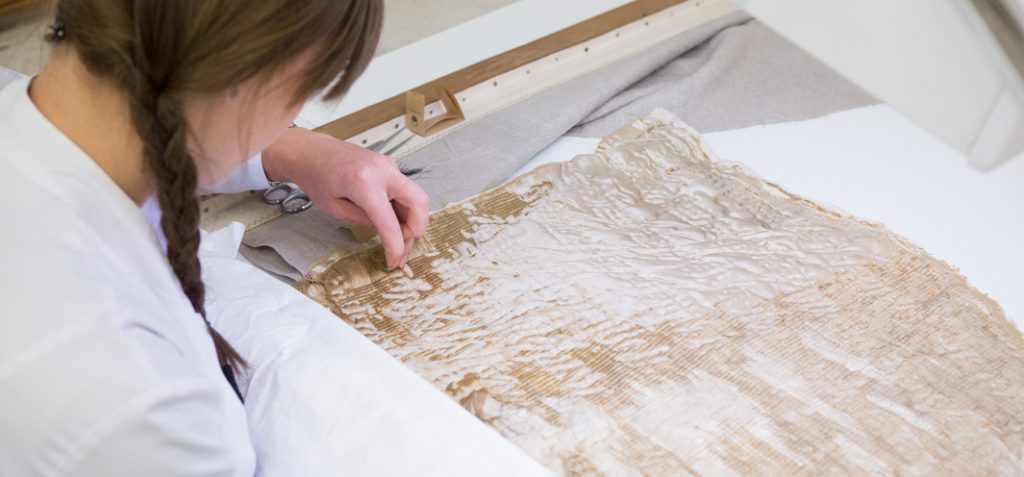
The first mention of textile conservation at the National Museum in Kraków dates from 1910. “We have succeeded in bringing the textiles and embroidery section into complete order. A number of damaged specimens have been repaired…” – the report states.
The Textile and Costume Conservation Workshop, which is currently in operation, was formally established in 1938. It is responsible for the conservation of all textile objects held in the various departments of our Museum: Textiles, Far Eastern Art, Orthodox Church Art, Arts and Crafts and Material Culture, Militaria, the Józef Mehoffer House, the MNK Matejko House and the MNK Czartoryski Museum. It is the largest and one of the most valuable collections of textiles in Poland. It comprises objects created using a variety of techniques and from various textile materials: archaeological textiles, tapestries, carpets, kilims, wall hangings, European and Oriental silk fabrics, liturgical vestments and paraments, banners, garments and fashion accessories.
The Workshop’s history, spanning almost a century, enables us to understand and evaluate the various conservation methods that have evolved over the course of the century. This allows us today to assess them objectively and helps us select the most appropriate conservation methods, in accordance with global standards and the ethics of the profession. All conservation work is carried out on the basis of programmes tailored individually to each object. We collaborate with specialists from various fields: chemistry, physics and microbiology. It is often the results of laboratory analyses that determine the methods used to conserve and display historic textiles. Due to the great diversity of artefacts in terms of materials, production techniques and original purpose, conservators are required to have comprehensive training and to continually expand their knowledge. This is facilitated by the exchange of experiences with other institutions both at home and abroad.
The Studio’s activities are not limited to the conservation of textiles. Preventative conservation is of paramount importance. Based on international standards regarding climatic and lighting conditions, textile displays in the galleries are regularly monitored. Systematic inspections are also carried out on textiles stored in the repositories.
Conservators also participate in organising exhibitions, issue conservation reports on the condition of the artefacts, and contribute to the risk assessment report for the collections of the National Museum in Kraków. A thorough analysis of all aspects of textile conservation (storage, display and transport) has led to organisational changes that enable us to counteract all threats more effectively.
Over the past years, the Workshop has carried out a number of significant conservation projects:
Since 2013, the workshop has been participating in the conservation and research project ‘The Tomb Banner of Jan Skarga Pawęski – research, conservation, exhibition’.
In 2014, one of the Textiles Department’s storage rooms was refurbished. Specialist equipment for the storage of artefacts was also purchased. This project was made possible thanks to funding from the Ministry of Culture and National Heritage.
Thanks to user-friendly, modern cupboards and shelving units, from September 2015 it will be possible to organise study sessions for small groups of visitors, dedicated to the history of historical textiles. We invite anyone interested to contact us regarding this matter.
+48 12 433 55 83
16th-century Turkish carpet with cintamani motifs
In 2015, the Textile and Clothing Conservation Studio of the National Museum in Krakow began conservation works on the 16th-century Turkish carpet with cintamani motifs. Its uniqueness lies in the fact that it belongs to a group of the largest preserved items of this type in the world – it is nearly 40 square meters large (1,063 cm long and 372 cm wide). It is this vast area that constitutes the principal difficulty and challenge for the team of textile conservators.
Based on the analysis of the composition as well as identification of motifs and techniques, carried out years ago by Dr. Beata Biedrońska-Słotowa, the creation of the carpet was attributed to the Turkish workshops active in the second half of the 16th-century in Cairo. In 1901, it was donated by the Corpus Christi Church in Krakow to the collection of the National Museum in Krakow. In accordance with the church tradition, the carpet was offered by Stanisław Jabłonowski, King John Sobieski’s colonel, after his return from the victorious battle in Vienna.
The carpet is very worn-out and preserved in eight parts, which raises questions regarding the purpose of such divisions. It can not be simply explained with the severance of the structure of the warp, weft and Persian knots resulting from damage caused during use. With their regular lines, some of the “cuts” attest to deliberate partitioning – perhaps based on the needs of the user or art collectors, fully aware of its value. One of the missing elements now remains in the collection of the Munich Ethnological Museum. Throughout the centuries, the carpet was subjected to multiple protective treatments. Their build-up is visible in form of various reinforcements, patches, and stitches made with various threads. The so-called local foundations consolidated the defective parts and prevented the item – somewhat provisionally from our perspective – from a complete dispersal of its elements.
A team of conservators, physicists, chemists and microbiologists suggested a very broad research programme for the carpet. Its aim is to develop an exhibition and protection strategy for this unique exhibit. The majority of research work will be carried out in the Laboratory for Analysis and Non-Destructive Research into Artefacts (LANBOZ), operating in the NMK since 2004, and by microbiologists from the Department of Microbiology of the University of Economics.
The conservation intervention is not meant to detract from the original elements of the object, so the aim of our conservation activities is the development of such methods of consolidation and stabilization of the carpet on a new woolen surface that will not compete with the visual aesthetics of the whole.
One phase of works has been completed. The carpet has been cleaned with excellent results. The colours, recovered from centuries-old layers of dirt, seem vivid. Ahead of us is the painstaking work, lasting many months, to restore this magnificent work, once decorating the palaces of the sultans, to the general public.
Anna Olkuśnik-Tabisz – the Head of the Textile and Clothing Conservation Studio