


 MNK Main Building
al. 3 Maja 1, 30-062 Kraków
Magdalena Abakanowicz’s fame came from the Abakans – monumental forms on the border between artistic fabric and sculpture. These organic compositions, woven from natural fibres, whose name derives from the artist’s surname, have permanently inscribed themselves in the history of 20th-century art.
In her later years, the sculptor turned towards reflections on the condition of humanity and its place in the world and in the collective. The depth of her philosophical considerations on human nature was illustrated by series of works composed of figures – much closer to conventional sculpture than the Abakans, but still extremely original and recognisable.
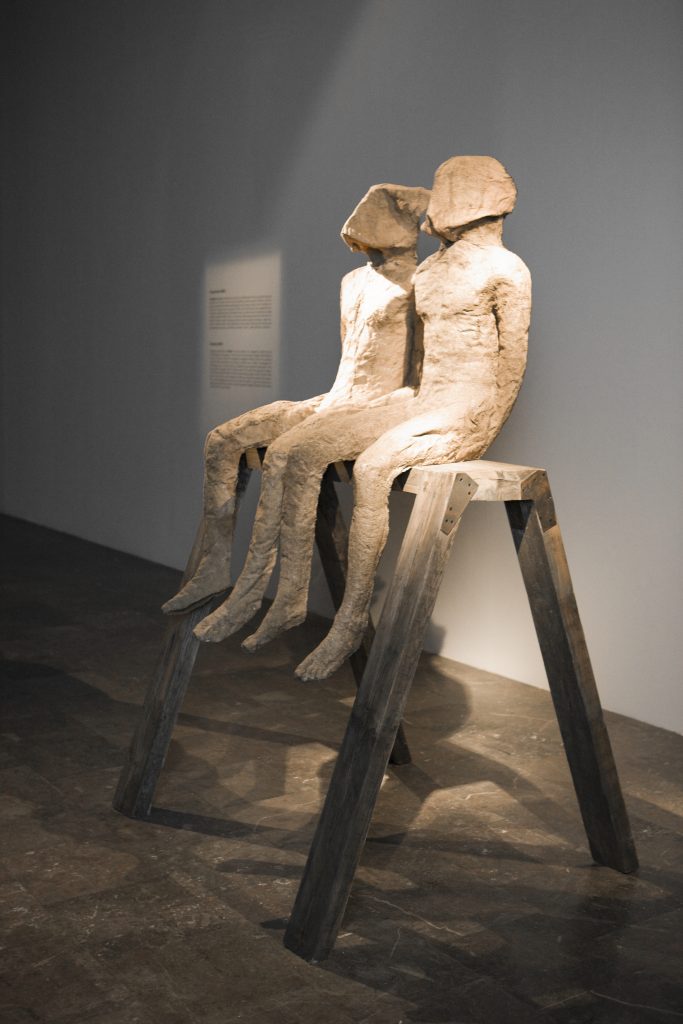
Abakanowicz created small groups and individual figures. She shaped them not only from traditional sculptural materials but also – returning to her artistic beginnings – from jute fabric. One such sculpture is the group of two seated figures, Friends. Jute – a raw fabric, considered ‘poor’, associated mainly with the most ordinary, cheap sacks – was, in a sense, elevated by the artist as a material from which works of such strong philosophical resonance were created. The mysterious pair of young men sitting next to each other in identical poses wear animal masks on their heads.
Magdalena Abakanowicz’s sculpture can also be interpreted as a reference to the lost closeness of humans and animals – to the idea that man should live in harmony with the surrounding nature, and animals should be treated with due dignity, as our ‘younger brothers’.
The purchase of the work was subsidised by the Minister of Culture, National Heritage and Sport from the Cultural Promotion Fund – a State Purpose Fund, under the National Collection of Contemporary Art programme.
Zapraszamy do poznania materiału o obiekcie w cyfrowym katalogu zbiorów Muzeum Narodowego w Krakowie. Autorka noty: Agata Małodobry
MNK Main Building
al. 3 Maja 1, 30-062 Kraków