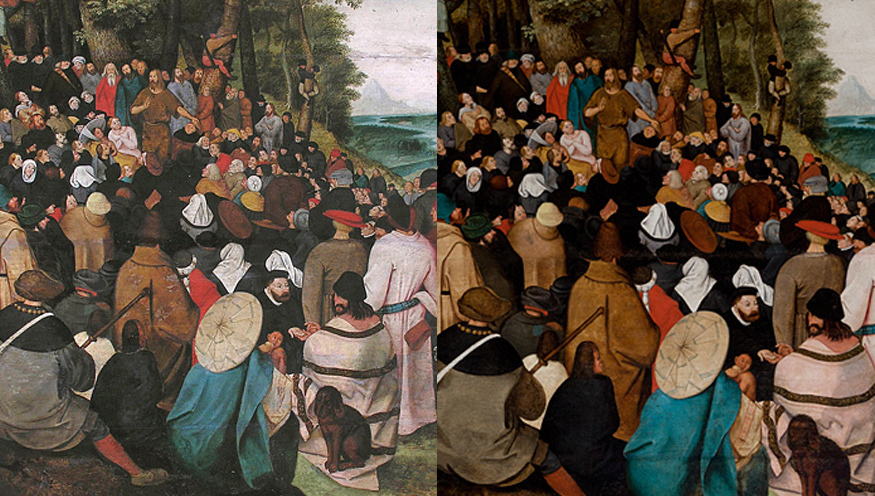
The Painting Conservation Workshop at the MNK Czartoryski Museum looks after the collection of paintings belonging to the National Museum and the MNK Czartoryski Collection. It was established in 1985 thanks to the long-standing efforts of Dr Marek Rostworowski, the head of the Department. The task of establishing and managing the Workshop was entrusted to Krystyna Bartel-Bochnak, an experienced conservator at the National Museum in Kraków.
One of the workshop’s first achievements was preparing the objects for the exhibition ‘Jews – Poles’, presented at the National Museum in Kraków in 1989–1990. The team’s key tasks included caring for the numerous paintings and works of decorative art – diverse in terms of technique and state of preservation – which were on display at the Klasztorek until 2011, as well as the ancient art exhibits at the MNK Arsenal, and preparing these objects for exhibition.
The studio exercises conservation supervision over the storage conditions and state of preservation of the greatest masterpieces in the collection – Leonardo da Vinci’s *Lady with an Ermine* and Rembrandt’s *Landscape with the Good Samaritan*; its tasks also include courier services involved in overseeing the objects whilst on loan.
The most significant international exhibitions to which *Lady with an Ermine* has been loaned (along with conservation supervision) include: The painting has also been loaned to overseas exhibitions showcasing Polish collections: The workshop specialises in historical painting; its staff make full use of a modern museum conservator’s workshop, whilst constantly bearing in mind the aesthetic values of the artefacts. Conservators also collaborate with specialists from many fields of science, which enables them to acquire extensive knowledge of the techniques, technology and history of the works. This allows them to devise the most appropriate and safe approach to handling the artefact.
The Studio’s most recent project involved preparing artefacts for an exhibition at the new branch of the National Museum in Kraków, EUROPEUM, where the most valuable works of European painting from the Kraków Museum’s collection are on display – by Lorenzo Lotto, Vlaminck, Bruegel, Strozzi, Cranach, Bellini and Dirck van Baburen.
+48 12 370 54 60
Landscape with the Good Samaritan
Landscape with the Good Samaritan by Harmens Rembrandt van Rijn, 1638, oil on oak panel.
The decision to undertake the restoration work was prompted by highly visible aesthetic changes on the picture’s surface. The darkening and dulling of the varnish, retouching that had altered the colour scheme, and surface soiling were distorting the colour scheme and diminishing the painting’s artistic merit.
The conservation work was accompanied by physico-chemical analyses: X-ray, ultraviolet, infrared and sodium light imaging were carried out, along with dendrochronological studies and analyses of pigments, binders and ground. These analyses provided a more detailed understanding of the painting’s technique and technology.
During the conservation process, the darkened secondary varnish and numerous old retouches, which partially obscured the original, were removed from the picture’s surface. The work was carried out under a microscope, utilising observation under ultraviolet light. Putty was applied to areas where mortar was missing, as well as to the support boards. The paint layer was re-adhered to the support.
Aesthetic conservation involved filling in losses in the paint layer to the extent necessary to ensure its integrity.
The conservation work fully restored the work’s original colour scheme and the clarity of detail, particularly in the darker areas of the painting, whilst also revealing its depth and perspective.
Date of conservation: 2003
Conservators: Katarzyna Novljaković, Anna Grochowska-Angelus
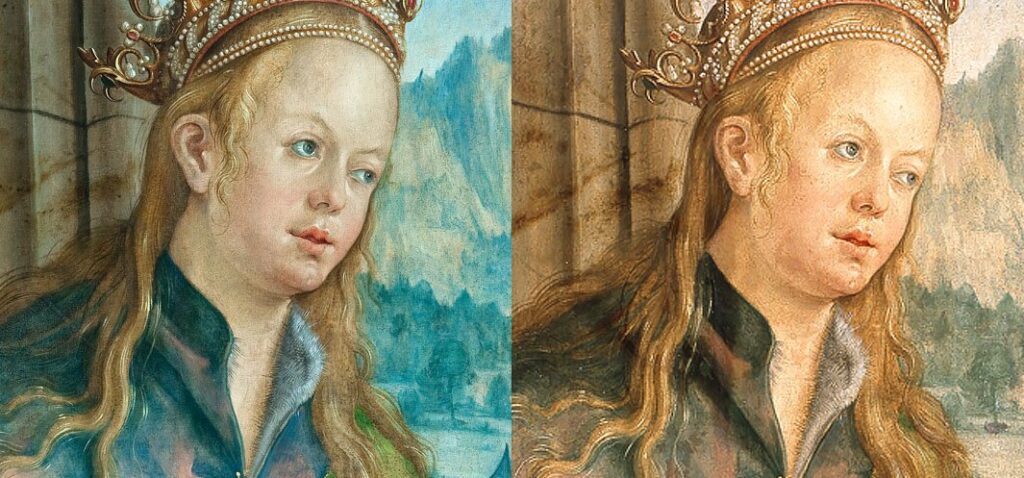
St Catherine of Alexandria
St Catherine of Alexandria by Hans Suess von Kulmbach, tempera on panel, a fragment of the obverse of the left wing of the altarpiece from the Church of the Pauline Fathers at Skałka in Kraków, dated 1511.
The triptych comprised depictions of the Adoration of the Magi, the figure of St Barbara on the obverse of the right wing, and four scenes from the life of Mary on the reverses. The altarpiece was dismantled and the panels were divided into sections. The depiction of St Catherine of Alexandria was purchased by the MNK Czartoryski Museum in 1895 from the prior of the Pauline Order. At that time, the painting was oval in shape.
In 1902, the painting underwent conservation work carried out by Alois Hauser, a highly regarded German specialist in this field and chief conservator of the painting gallery at the Kaiser-Friedrich-Museum in Berlin. He transformed the painting’s oval shape into a rectangular one by adding a support and restoring the paint layer.
Between 1999 and 2001, the painting was conserved by Małgorzata Chmielewska. The painting underwent detailed examination – X-rays, ultraviolet and infrared photographs were taken, and analyses were carried out on the pigments, binders, ground and support. Prior to conservation, the painting was covered with several layers of yellowed varnish; once these were removed, the significantly darkened areas where the varnish had been retouched became visible. This was the reason for the decision to retain only the original painting. Whilst removing the colour-altered retouches, it was discovered that one of the panels of the oval support bore the remains of a completely different painting. Pigment identification tests showed that this fragment did not originate from the Kulmbach triptych. When restoring the paint layer, the principle of minimal intervention in the preserved painting was followed. For this reason, Hauser’s reconstructions were not replicated. The guiding principle behind the current conservation work – to showcase Kulmbach’s work exclusively in its authentic form – necessitated the design of a new frame. The oval shape of the painting was emphasised by adding an oak overlay – thus concealing the secondary rectangular support panel. A recessed frame with a coffered profile was also created, gilded and polychromed in two colours, featuring a selected ornament. In doing so, designs were drawn from existing examples of 16th-century frames.