


06.03.26 – 31.01.27


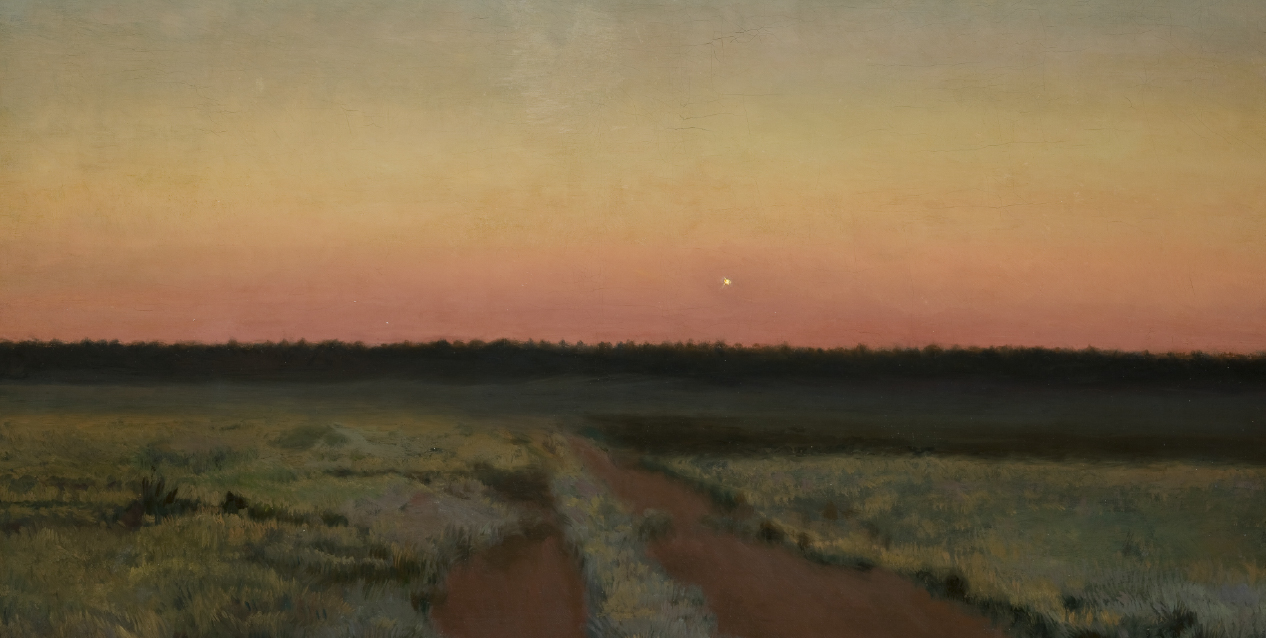
“Landscape of the Polish Soul” is an exhibition that forms part of a tradition, now spanning more than a decade, of presenting Polish art within the Presidential Palace of the Republic of Poland, organised by museum institutions.
Depicting, even in broad strokes, the landscape of the Polish soul requires posing two obvious, yet difficult, questions – about the essence of Polishness, and about the sources of how it is felt, that is, about what has shaped our consciousness. The narrative of the exhibition is built around precisely these questions. The small exhibition, comprising thirty-three works, is, however, by its very nature not so much an attempt at a complete answer to these questions as merely an outline, a kind of ‘impression on the subject of…’.
That certain something which makes us perceive a given motif, tone or characteristic as Polish cannot always be precisely named or put into words. The answer to the question of the essence of Polishness is therefore always to some extent subjective, as are the results of the search for its visual expression, which is crucial in the context of creating the exhibition.
It seems, however, that it is easier to identify the sources of the Polish collective sensibility. A shared past and history are among the most important of these, particularly the history of the 19th century – a century of national uprisings and the struggle for independence, during which we took shape as a modern nation. This is one of the dominant themes of the exhibition, which is also an attempt to view the 19th century through the prism of Polish Romantic literature – its two masterpieces: Zygmunt Krasiński’s Przedświt (1843) and Juliusz Słowacki’s Anhelli (1838).
Religion and faith in God, deeply woven into Polish history and culture, are another of the factors that have shaped us, as the exhibition illustrates, whilst also drawing attention to the sacred in a broader sense, of which art is a manifestation. The Polish landscape, rich in atmosphere, evokes a sense of the mystical unity of the sacred and nature, as evidenced by the works on display by several artists from the second half of the 19th century and the turn of the 19th and 20th centuries.
The exhibition ‘Landscape of the Polish Soul’ has been arranged in the series of representative rooms of the Presidential Palace, comprising the Antechamber, the corridor leading to the Office of the President of the Republic of Poland, the Column Hall, the Picture Gallery, and the staircase adjacent to the latter.
On display are works by artists such as: Piotr Michałowski, Leon Kapliński, Aleksander Kotsis, Adam Chmielowski, Józef Chełmoński, Witold Pruszkowski, Stanisław Witkiewicz, Leon Wyczółkowski, Jacek Malczewski, Roman Kochanowski, Jan Stanisławski,
Józef Czajkowski, Stanisław Kamocki, Henryk Uziembło, Wlastimil Hofman, Stanisław Podgórski, Tadeusz Makowski, Zbigniew Pronaszko and Józef Czapski.
We would like to express our special gratitude to the four museums that have kindly made their works available to us, which are of immense importance to the concept of the exhibition:
The exhibition is accompanied by an illustrated guide.
Exhibition curator: dr Beata Studziżba-Kubalska
Koordynacja wystawy: Aleksandra Kłaput
Aranżacja wystawy: Marta Staszków