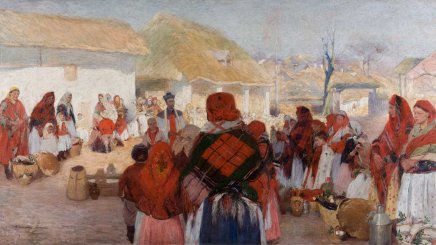
The National Museum in Krakow has prepared its second art presentation in the Presidential Palace. It is centred around indigenous traditions and customs, which are reflected in Polish painting of the 19th and 20th century. The exhibition consists of 39 paintings depicting Polish religious and secular traditions associated both with folk customs and the ethos of the gentry.
‘The calendar of liturgy and rituals of the Catholic Church served as key to the selection of nearly forty works, though pieces related to broadly defined culture of the gentry were also displayed. This is the first exhibition of this type in the history of Polish museums’ – the NMK Director Andrzej Betlej wrote in its catalogue.
Paintings by Józef Chełmoński and Leon Wyczółkowski devoted to the cult of the Virgin Mary constitute the focus of the Column Hall. They are accompanied by works of Jacek Malczewski, Włodzimierz Tetmajer, Witold Pruszkowski and Marian Zarembski depicting worship services and private prayers.
The painting Hall presents works related to Christmas and Easter celebrations, including works by Jacek Malczewski, Włodzimierz Tetmajer, Józef Chełmoński, Tadeusz Makowski, Ludwik de Laveaux, Teresa Roszkowska. They are complemented by works by Teodor Axentowicz, Józef Czajkowski and Antoni Piotrowski referring to the Feast of the Presentation of the Lord – commonly called the feast of Candlemas, processions through the fields, and folk wedding customs.
The Antechamber is decorated with works by Michał Stachowicz – the first Polish painter who depicted Polish customs and rituals – and those by Artur Grottger and Franciszek Kostrzewski.