


 MNK Wyspiański
pl. Sikorskiego 6, 31-115 Kraków
The ‘Gardens of Women Sculptors’ project is an educational trail that combines the pleasure of a stroll with learning about women’s art. By visiting the gardens of our museum branches, you will be able to discover the work of female artists who have shaped the landscape of Polish sculpture from the late 19th century to the present day.
Not all visitors to the National Museum in Kraków are aware that, in addition to its priceless art collection, the Kraków museum boasts several magnificent gardens and stylish courtyards. The historic garden of the MNK Czapski Branch was added to the Małopolska Garden Trail in 2018, and in addition to ornamental plants and a historical lapidarium, it houses works by two outstanding female sculptors: Morpheus by Teofila Certowicz, donated by the artist to the National Museum in 1903, and Walking Figures by Magdalena Abakanowicz. A group of three cast-iron figures by the world-famous Polish artist has been situated at the rear of the garden since 2023. In the courtyard of the MNK Wyspiański, a set of three sculptures by Barbara Falender is on display, carved
from Dębnik limestone, known as ‘black marble’: Sarcophagus (for Mother), Sarcophagus for Parents and Hommage to Alina Szapocznikow, a gift from the artist to the National Museum in Kraków. The donation of the latter sculpture to our Museum will be marked in April this year with a ceremonial unveiling. In accordance with Barbara Falender’s wishes, the stone sculptures are presented together, forming a highly personal funeral triptych – for all three reflect on transience and death. The artist wished for them to be located in Kraków: the city where the long history of Dębnica limestone as an architectural and sculptural material began.
Agata Małodobry
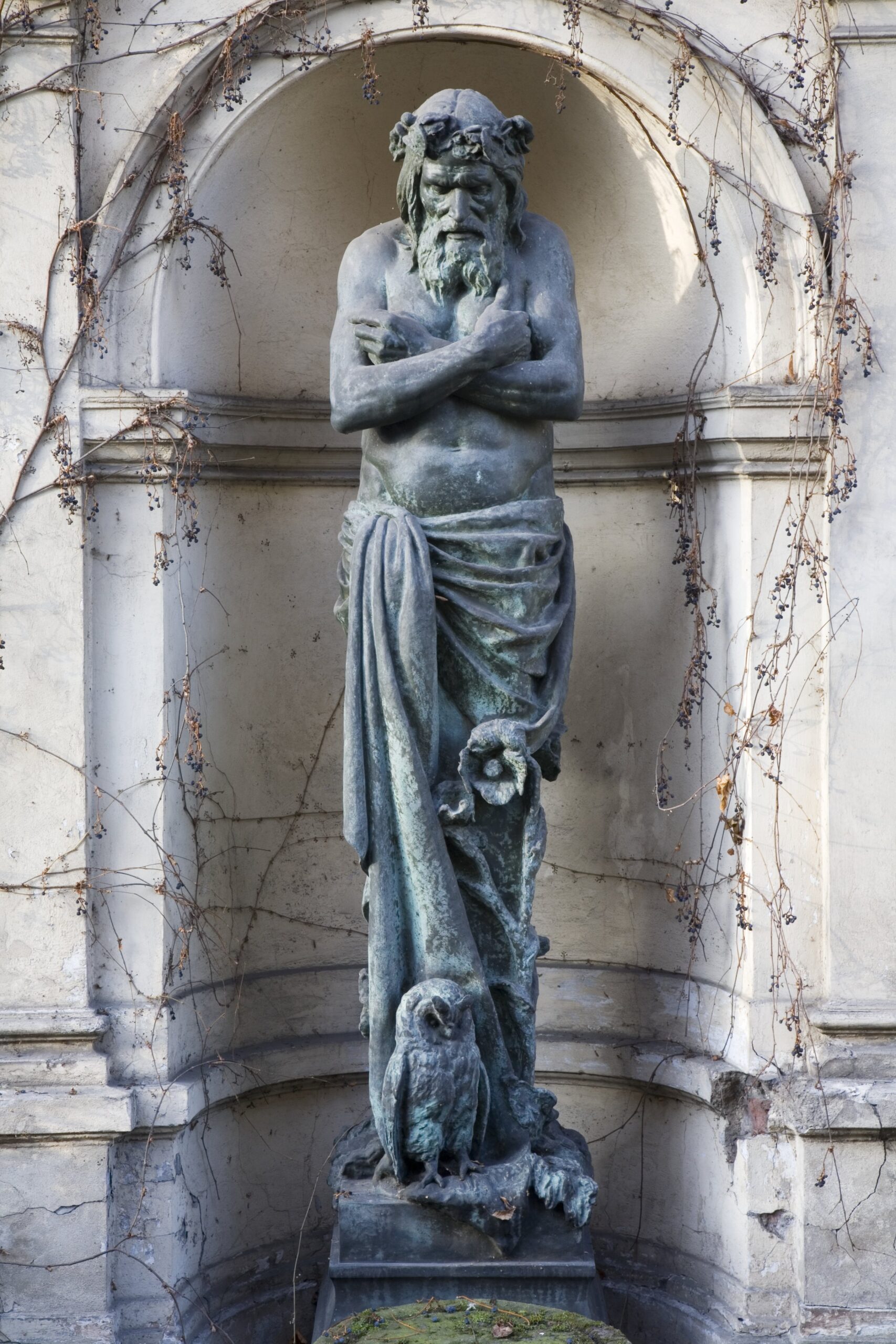
Teofila (Tola) Certowicz (1862–1918)
Morpheus
1889
bronze
A gift from the artist to the National Museum in Kraków, 1903
The sculpture forms part of a fountain in the garden of the MNK Czapski Palace. The statue is situated in a wall niche of an aedicule topped with a triangular pediment. Morpheus is depicted as a bearded man in his prime. His head is entwined with a wreath of stylised poppy flowers and fruits, and his hands are crossed over his bare torso. A densely draped fabric adorned with poppy flowers is wrapped around Morpheus’s hips, whilst an owl – a bird of the night – perches at his feet. These attributes recall the characteristics of the god of dreams: the son of Hypnos and nephew of Thanatos. The composition’s subdued ornamentation is striking: the dominant vertical direction is enriched with asymmetrical accents – the fanciful drapery and oversized decorative flowers, as well as the depiction of the owl. Certowiczówna’s work exudes a reflective, poetic aura, which makes it a precursor to Symbolism in Polish sculpture. The cast was made in Paris, as evidenced by the inscription on the plinth and the signature of the French foundryman.
Magdalena Abakanowicz (1930–2017)
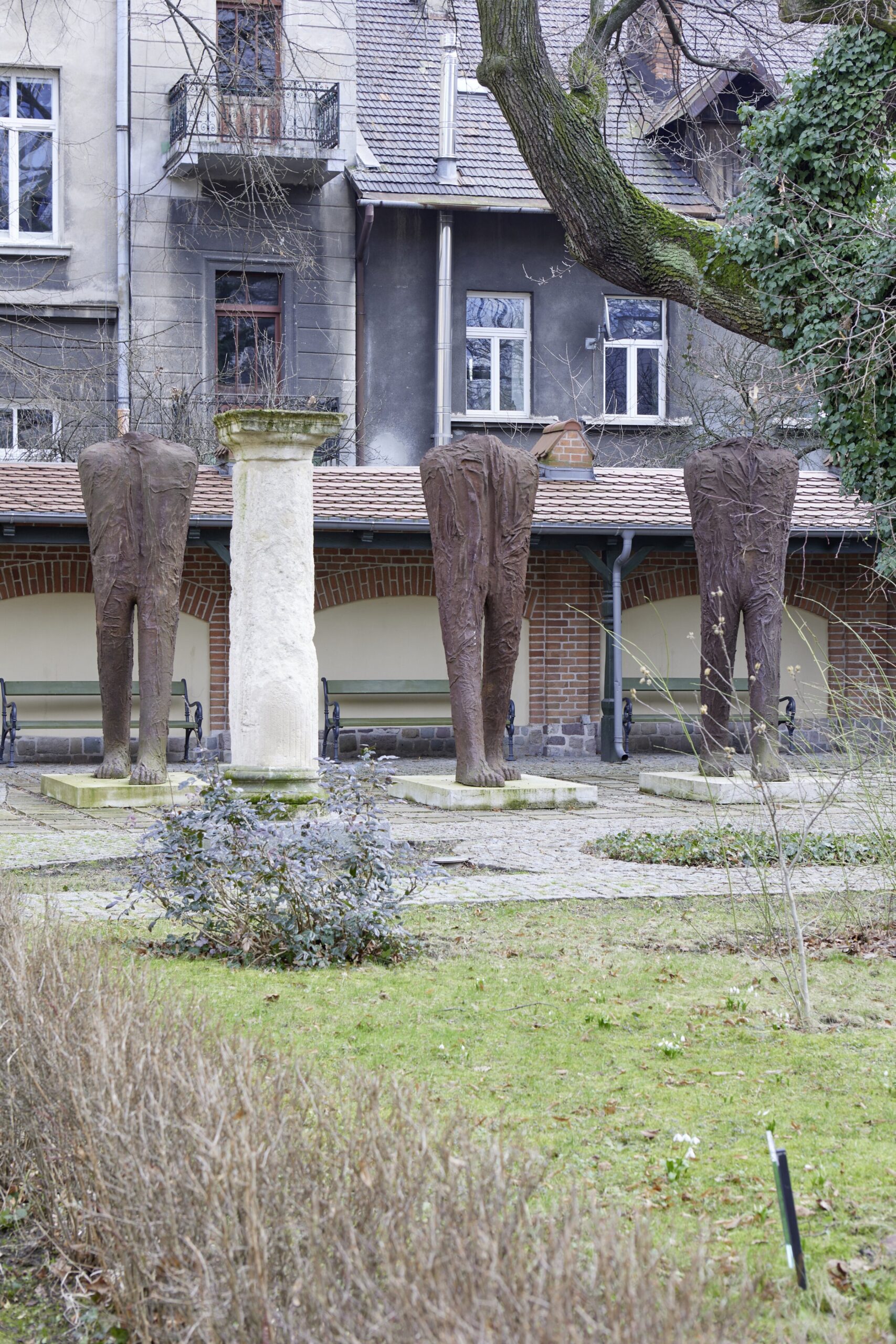
Walking Figures
2005–2006
cast iron
On loan from the Marta Magdalena Abakanowicz-Kosmowska and Jan Kosmowski Foundation
Three headless figures with simplified anatomy appear to consist solely of elaborate torsos and legs
with massive feet, captured in a dynamic stride. The varied texture of the sculptures’ surfaces evokes biological connotations: it resembles wrinkled skin or tree bark. This latter association brings them closer to their surroundings: the mature trees of the MNK Czapski Palace garden. These are not figures, but empty shells; forms left behind by imagined figures. They symbolically remind us that each of us will leave a lasting mark behind. All the sculptures, like their counterparts in the multi-figure ensembles in Poznań, Chicago and Vancouver, have been shaped in a unique way: they differ in the arrangement of furrows and drapery on their surfaces. Combining the permanence of nature with the dynamism of the moment, they remain in harmonious relationship with one another, with the surrounding natural world and with the people visiting the MNK Czapski Garden.
Barbara Falender (b. 1947)
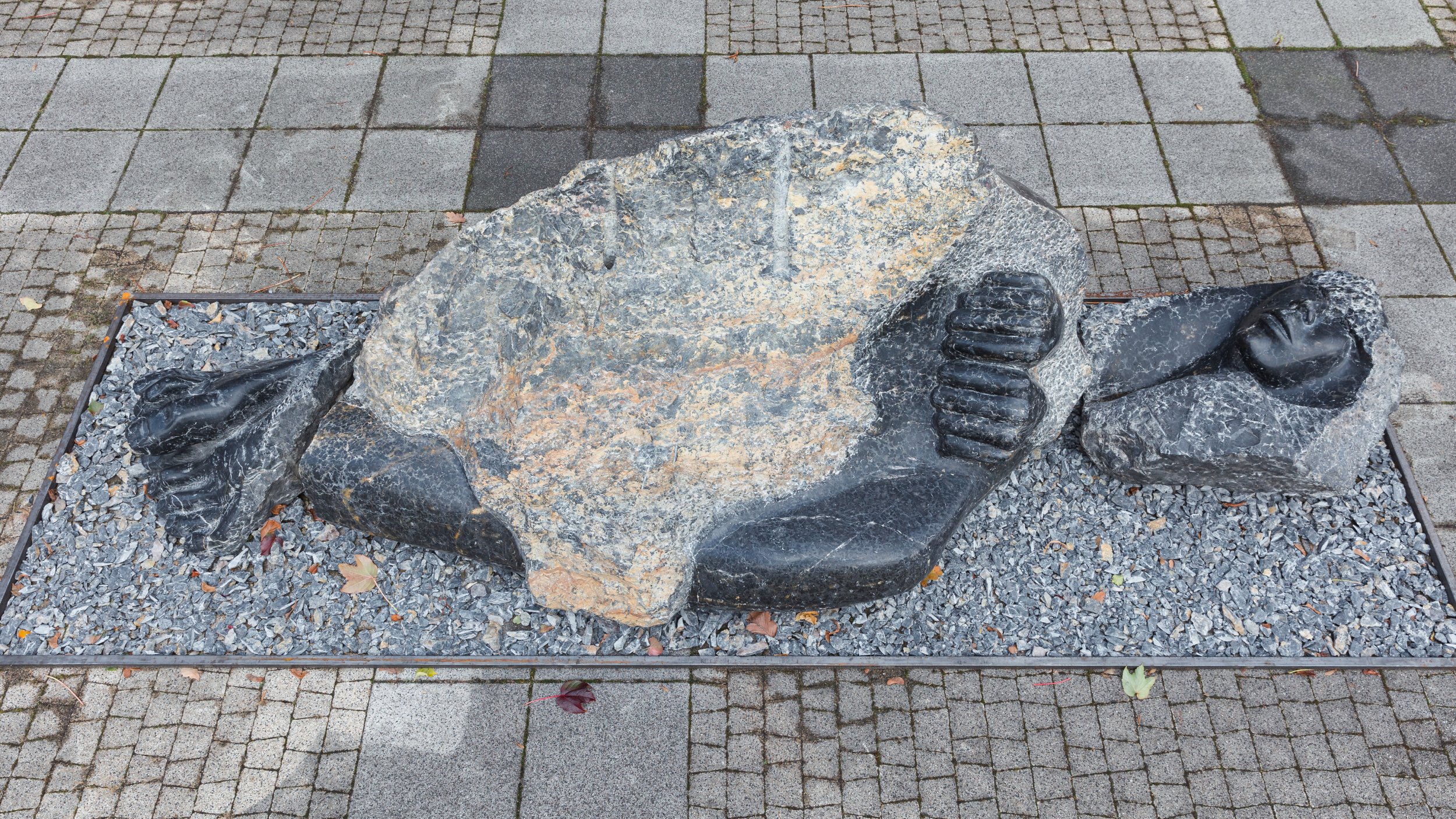
Homage to Alina Szapocznikow
2023
black Dębnik limestone
Gift from the artist
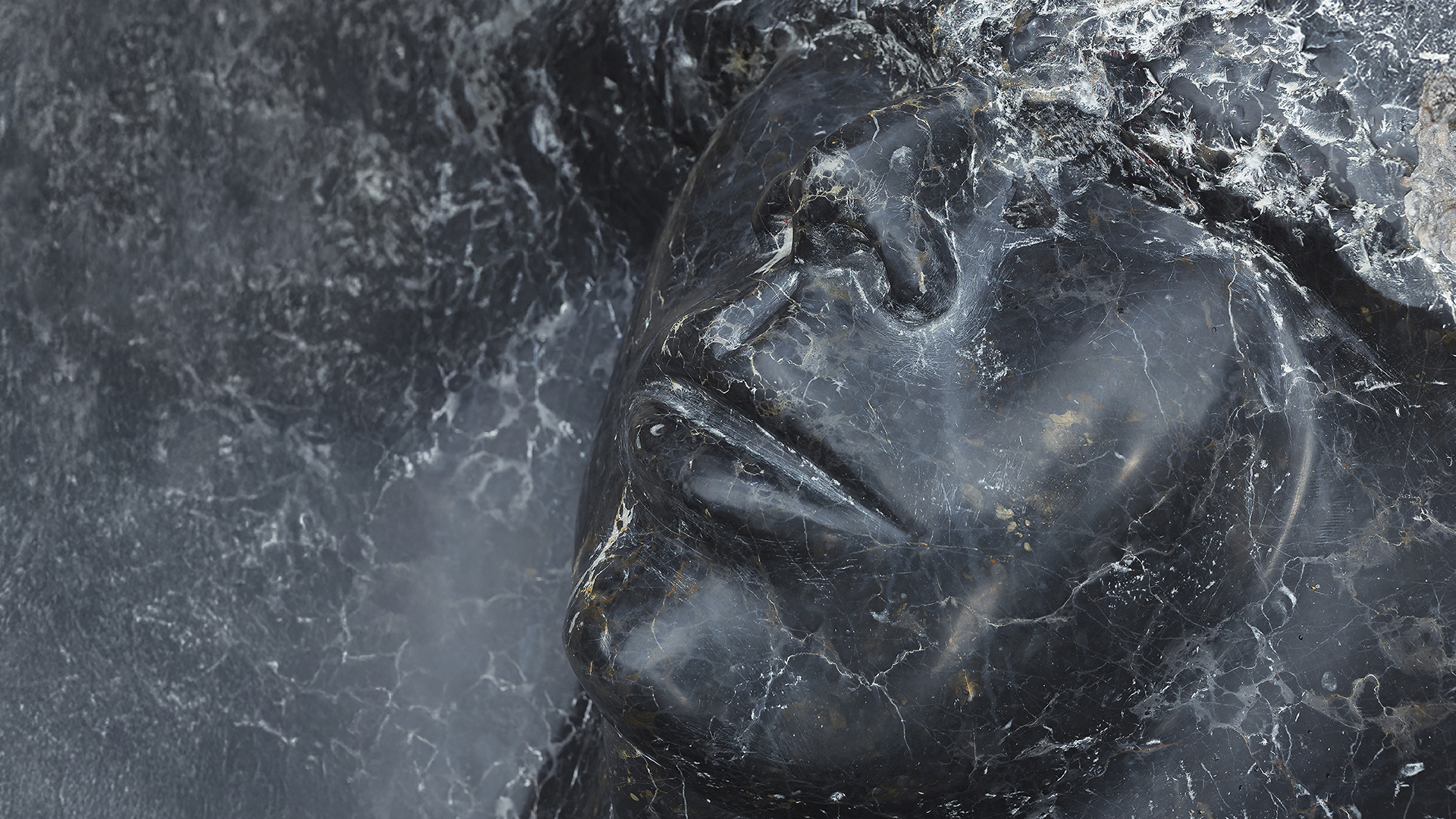
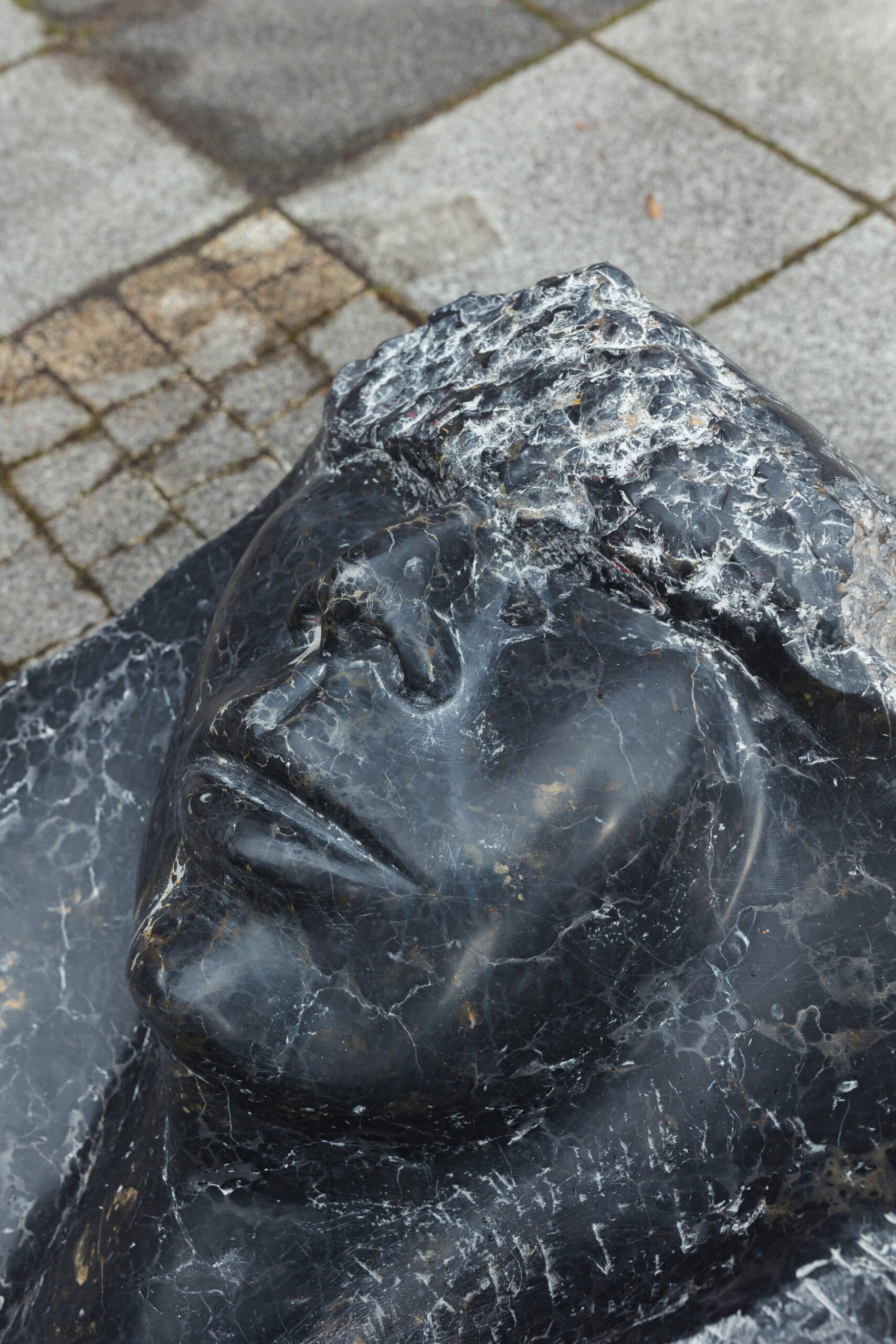
Barbara Falender created this work as a tribute to the great Polish sculptor Alina Szapocznikow (1926–1973).
She never met her in person, but she often emphasised the metaphysical bond that connected her to Szapocznikow. The sensual way of thinking about the human body manifested in Alina Szapocznikow’s work is very close to Barbara Falender’s heart. The monumental sculptural composition consists of three separate parts that form a reclining female figure: the face, the torso covered with a quilt, and the crossed feet. The details of the body are meticulously polished, and the noble sheen of the surface brings out the deep, dark colour of the stone.
The smoothness of the sculpted body contrasts with surfaces that the artist has left unfinished, unworked or only roughly hewn. The organic, raw character of these matt sections serves as a reminder of the very process of sculpting – of the emergence of a bodily form from a block of stone. It is, after all, an expression of reverence paid by one sculptor to another. The first version of the sculpture was created in 1978 and remains in Warsaw to this day: in a public space on Ostrobramska Street.
Barbara Falender (b. 1947)
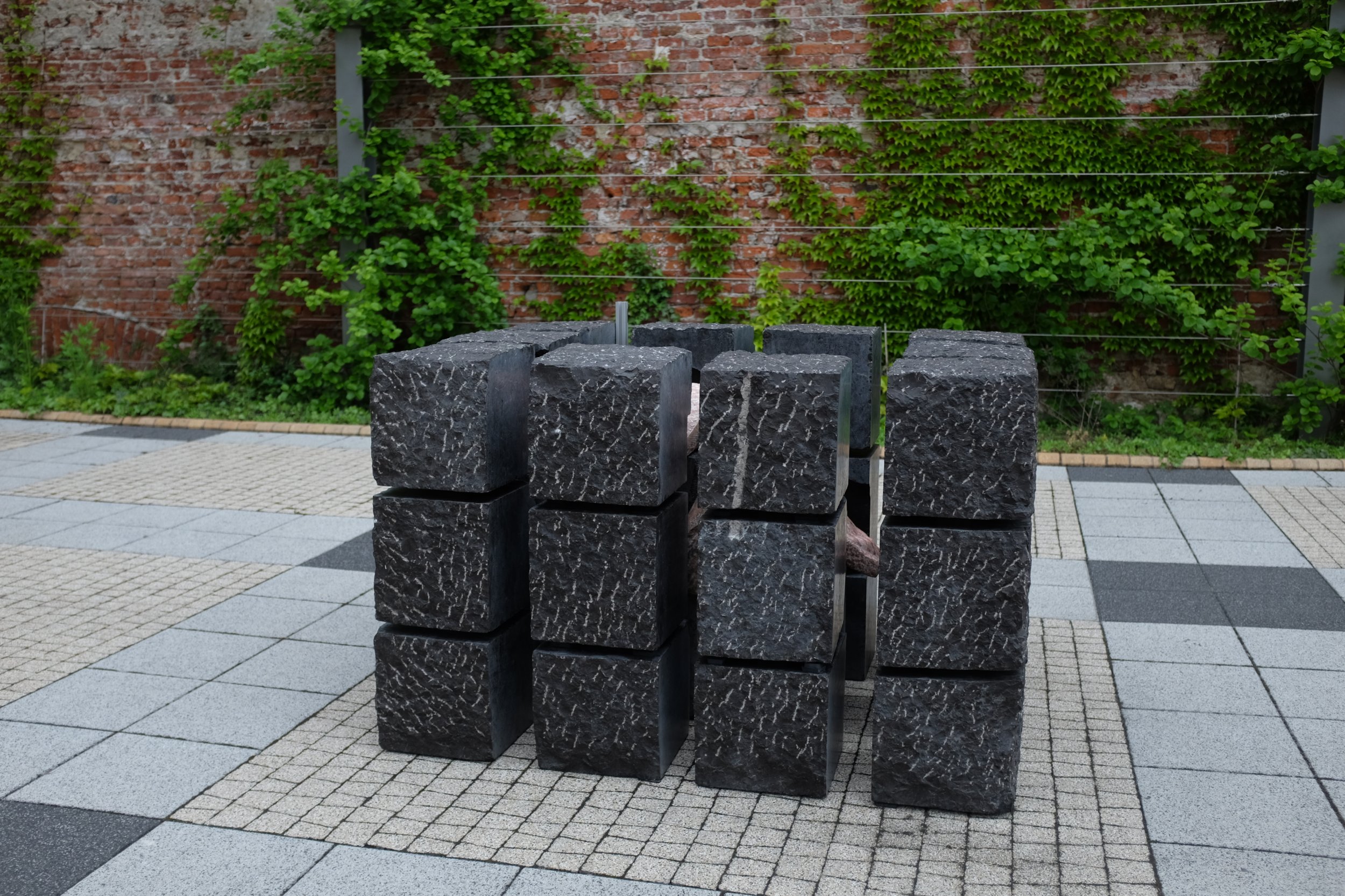
Sarcophagus (for my mother)
1993
black Dębnik limestone, pink marble
Sarcophagus (for my mother) consists of thirty cubes carved from Dębnica limestone. Arranged closely
in the shape of a rectangular chest, they form a minimalist spatial structure – based on the rhythms of lines intersecting at right angles. Inside the sarcophagus, Barbara Falender has placed a sculptural epitaph for her mother. By separating the sculpture from viewers approaching from outside, the artist conveys the intimate nature of this work: it should not be touched; this is the privilege of the artist – the daughter. To see what is inside, one must bend down, that is, perform a gesture typical of funeral ceremonies, symbolically taking part
in the farewell to the deceased. Inside the sarcophagus, much like a reliquary, Falender has arranged fragments of a woman’s body
in a loose composition: a face, a hand with an outstretched index finger, a foot, a fragment of a leg. The artist carved them from pink marble – a stone that is almost transparent in places, covered with a network of veins, and unevenly coloured like human skin beneath which blood circulates. By combining fragments of a realistically rendered body with a cube – one of the perfect Platonic solids – Barbara Falender has united in this sculpture that which is transient with that which is eternal.
Barbara Falender (b. 1947)
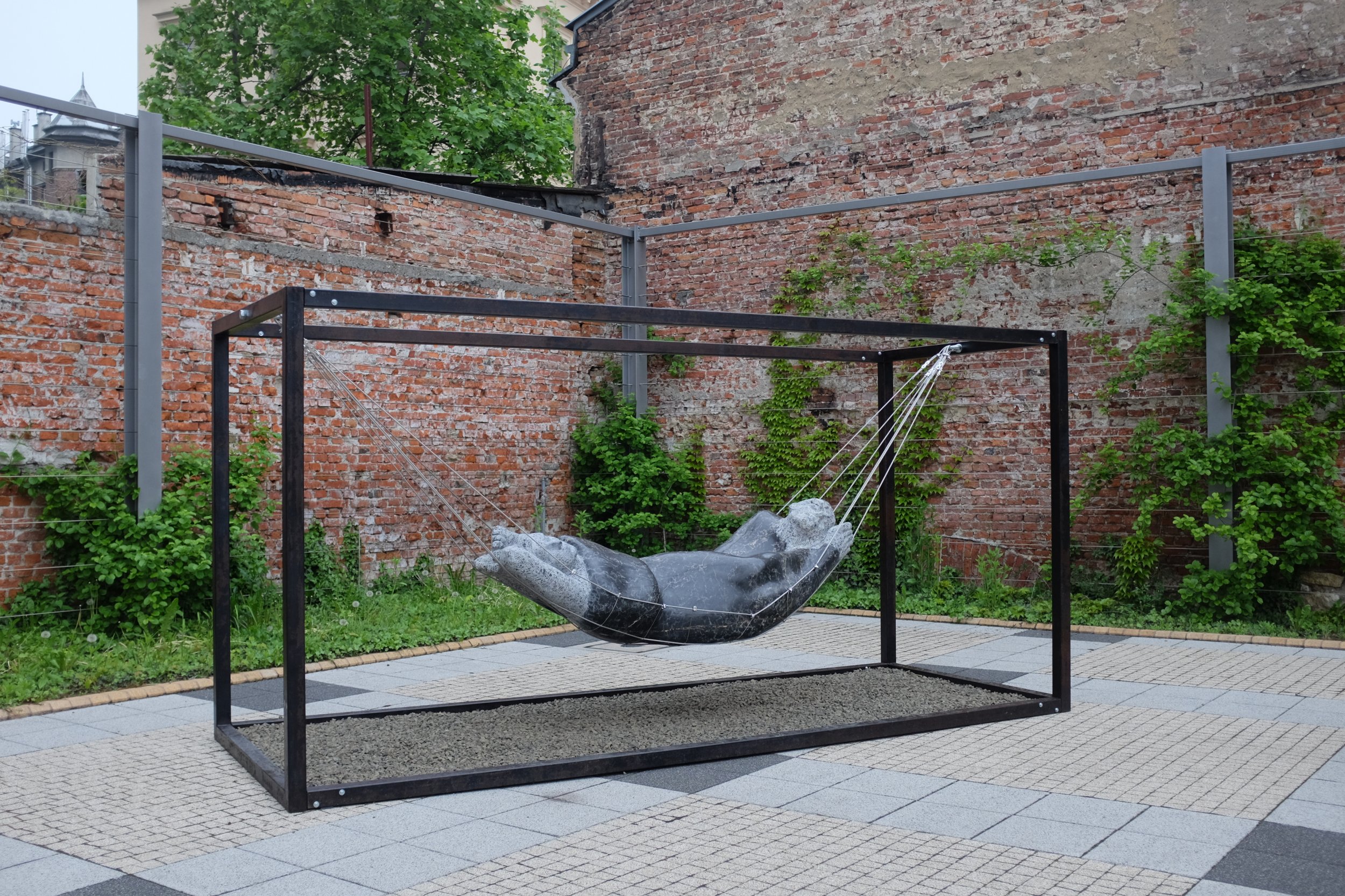
Sarcophagus for Parents
2011
black Dębnik limestone, steel
Acquired under the Ministry of Culture and National Heritage’s ‘Regional Contemporary Art Collections’ programme, 2016
The sculpture is a reference to ancient sarcophagi, particularly Etruscan ones, in which married couples were depicted with great tenderness. It also alludes to the shape of a cradle, evoking peace
and security. This work was preceded by numerous drawing and sculptural studies, as the artist sought the most perfect way to capture the intended composition. The actual weight of the stone block is balanced by the lightness of the depicted scene: the titular parents are rocking in a hammock, sleeping under a single duvet. Mother and father lie symmetrically opposite each other, their feet touching the other’s cheeks.
In this way, they form a closed whole. They complement one another, each dependent on the other and vice versa; they are a unity formed by love. In this work, as in the earlier Sarcophagus, corporeality merges with geometry. The reclining parents are suspended in a hammock stretched across a steel frame in the form of an open, linear cuboid. In the drawings preceding the creation of the sculpture, an idea is clearly visible which, in the final version, took the form of a subtle allusion to the original concept: initially, the artist envisioned the sarcophagus as a sculpture supported by four pillars. The figures of four young women sitting on the pillars are the daughters of the commemorated couple: the artist and her three sisters. The sculpture is interactive – the hammock can be gently rocked. “The movement of the stone mass is a contradiction of its natural stillness. It is a metaphor for solace and overcoming death,” explained the artist.
Barbara Falender was born in 1947 in Wrocław. She graduated in sculpture from the Academy of Fine Arts in Warsaw, having studied under Jerzy Jarnuszkiewicz. Since her debut in the 1970s, the human body has occupied a central place in her work, both in its sensual aspect and in the context of transience and death. The artist practises sculpture in the most classical sense: she carves most of her works by hand in stone. Occasionally, she creates castings in bronze as well as synthetic materials. Despite its traditional character, Barbara Falender’s art remains highly relevant. Solo exhibitions showcasing the artist’s work are held regularly. Over the past year, she has taken part in major group exhibitions: The Plastic Body. Sculpture from Poland 1960–1989 at the Stavanger Kunstmuseum in Norway and We Want a Whole Life! Feminisms in Polish Art at the State Art Gallery in Sopot.
Agata Małodobry

 MNK Wyspiański
pl. Sikorskiego 6, 31-115 Kraków