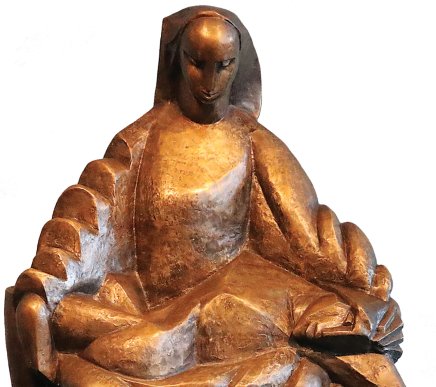
The exhibition, organised by the Chancellery of the President of the Republic of Poland in conjunction with the National Museum in Krakow, will be held in the foyer leading to the Chapel in the Presidential Palace. In keeping with the religious character of its location, the exhibition will focus on the sacral art of the Formists, an artistic group established in Krakow in 1917 by Tytus Czyżewski and the brothers Andrzej and Zbigniew Pronaszko.
“The three of us decided to establish an association of extreme modernists to resist the idiocy and general paralysis that reigned supreme in Polish art at that time,” wrote Czyżewski. Originally, the group referred to itself as the Polish Expressionists, changing its name in 1919 to the Formists. “Formism aspires to pure beauty and the feelings of joy and enthusiasm connected to beauty,” stated the group’s main ideologist, Leon Chwistek. Drawing on the experience of the Cubists, Expressionists, and Futurists, the group aimed to create a modern, avant-garde, national style.
“The rebirth of the Polish Republic in 1918 was preceded by the birth of a movement which would radically change the face of Polish art. The artists who took part in the Exhibition of Polish Expressionists beginning on the 4th of November 1917 gave rise to a new beginning of creativity and aesthetic thought among Poles. The works then presented in the building of the Society of the Friends of Fine Arts in Krakow opened a new chapter in the history of Polish art. This gesture by the Formists expressed a will to modernise the visual arts and the language of artistic expression with which those creative individuals chose to speak to their contemporaries.” writes Andrzej Duda, President of the Republic of Poland, in the introduction to the exhibition catalogue.
“From the beginning of their activities, the Formists concentrated on sacral art, finding in it an inspiration to search for spiritual content, a new expression based on the intensification of feeling, and a return to the emotional experience of artistic works. The aim of this exhibition is to show this less well-known aspect of the Formists’ output, and to emphasise that artists are capable of combining elements of the national tradition such as Catholic religious experience with an avant-garde form” writes exhibition curator, Dr. Andrzej Szczerski, Deputy Director for Academic Affairs of the National Museum in Krakow.