





 MNK Szołayscy
pl. Szczepański 9, 31-011 Kraków
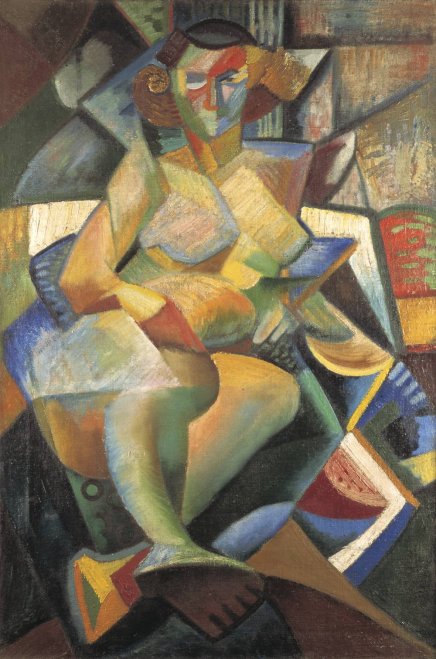
All of them studied at the Academy of Fine Arts in Krakow. Leopold Lewicki was the first to join the school, in 1925, whereas Sasza Blonder was the last to do it, in 1931. During studies, they would get awards over and over, sometimes for paintings, other times for drawings or sculptures; but they all rebelled against academic art, against their professors’ art stemming from the Young Poland movement. The artistic rebellion was just one part of their revolutionary stand, the war on fascism and Sanation, mainly within the Communist Party of Poland, conducted despite a serious threat to their lives. As early as in 1930, when the group had merely started to form, Henryk Wiciński was accused and sentenced to one month of imprisonment for spreading communist leaflets in front of a wire factory. In 1931, students representing the National Democracy (ND) started to remove left-wing students from classes. A few incidents happened and what is characteristic is the fact that also those who defended themselves against the attack, including Lewicki, Wiciński, and Winnicki, were reprimanded by the rector.
They referred to the concept of avant-garde art, and inter-war period critique indicated their relations with Cubism, Futurism, Constructivism, Expressionism and – what is paradoxical from the modern point of view – directly with Impressionism. As always in such cases, we can say: it has all been before, there is nothing new. It seems that in this way the freshness and novelty of the works of Krakow Group’s artists were for a long time overlooked. True, the starting point for the Group’s artists was earlier avant-garde, they consciously continued this program, while moving forward at the same time. Maybe the one who saw it clearly was Leon Chwistek, sponsoring the Group since its beginning. However, it is interesting that in making these references, members of the Krakow Group were far from purity or doctrinaire. What is more, they were slightly eclectic, drawing freely from various programs. Similarly, they took a lot from the professors they fought with: Pautsch, and even Kamocki and Jarocki. However, what they learned at the Academy, fitted into the narrowest understanding of the skill, coming down almost to the way of applying paint. Their ideas, on the other hand, came from the avant-garde. It is interesting though, that as opposed to Warsaw and Łódź avant-garde, they were far from Bauhaus tradition, they were interested neither in the relationship between painting and architecture, nor in applied art, nor in organizing space around people through art. Maybe that was because doctrinaire and totalitarianism of solutions did not appeal to them at all. They treated their paintings and graphics as a weapon to fight within the sphere of consciousness.
MNK Szołayscy
pl. Szczepański 9, 31-011 Kraków